Product Description
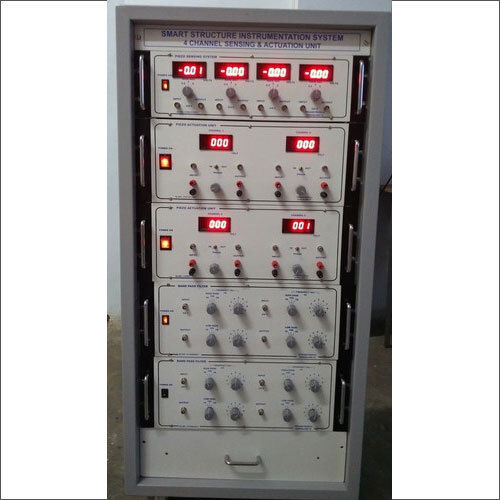
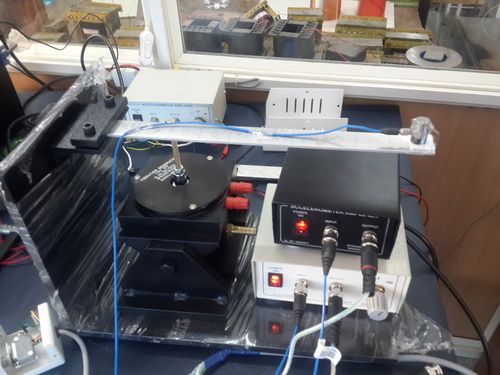
Determination of Transmissibility System
Transmissibility is defined as the ratio of the mass displacement or force between two points
EQUIPMENTS:
- Elecrodynamic Shaker
- Power Amplifier
- Vibration Table
- Accelerometers (2)
- PC base data acquisition system
The foundation can be represented by the vibration Table, where in the electrodynamic shaker is attached to the vibration table,
|
Transimissibility =
|
Y
|
Tip Displacement
|
|
Ys
|
Base Displacemen
|
Transimissibility indicates Isolation efficiency parameters.
Precision Engineering for Industrial ApplicationsThis transmissibility system is tailored for rigorous industrial demandsaccommodating a wide voltage range and rapid response times. The robust enclosure and quality materials assure dependable operation in challenging settings, while compliance with CE and ISO standards confirms its suitability for critical measurement and automation tasks.
Versatile and Secure Mounting OptionsEasily adaptable to various setups, the unit supports both panel and DIN rail mounting, making it compatible with new and existing infrastructure. The integrated insulation box and protection features provide peace of mind by safeguarding against surges and overloads in dynamic electrical environments.
FAQs of Transmissibility System:
Q: How is the Transmissibility System installed in different industrial setups?
A: The system is designed for flexibility, supporting both panel and DIN rail mounting. This allows for seamless installation in control panels or standalone applications without requiring extensive modifications.
Q: What benefits does the integrated overload and surge protection offer?
A: The built-in overload and surge protection ensures the systems longevity by preventing damage from electrical spikes, protecting both equipment and operators in high-activity industrial environments.
Q: Where can this system be effectively used?
A: It is ideal for use in industrial automation, measurement, control panels, and electrical testing, especially in environments where precise monitoring and durable construction are essential.
Q: When should recalibration or maintenance be performed?
A: Recalibration intervals depend on application intensity, but routine checks every 6 to 12 months are recommended to maintain the systems 1% accuracy and optimal performance in demanding operations.
Q: What is the process for connecting input and output signals?
A: Inputs are connected via the 4-terminal input connection, while outputs can be set as analog or relay signals, ensuring compatibility with a wide range of monitoring and control devices.
Q: How does the system handle extreme humidity and temperature conditions?
A: It operates reliably in 5%95% relative humidity (non-condensing) and at temperatures ranging from -20C to +60C, thanks to high-grade industrial materials and an IP54-rated enclosure.






 Send Inquiry
 Send Inquiry
 Send SMS


 English
 Spanish
 French
 German
 Italian
 Chinese (Simplified)
 Japanese
 Korean
 Arabic
 Portuguese