Product Description
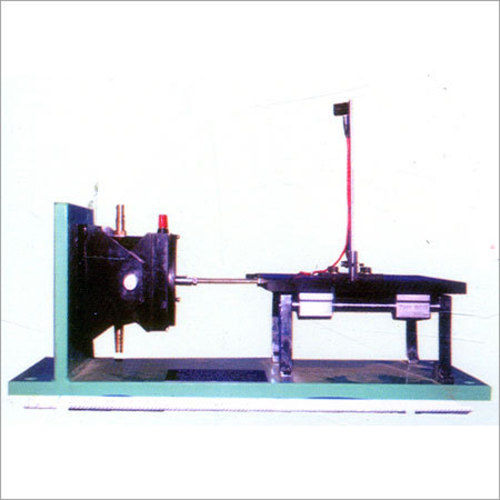
Beam Transverse Vibration
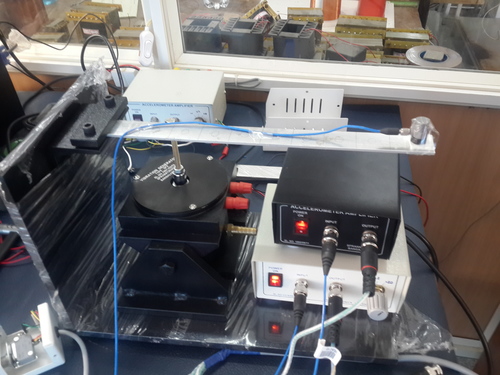
Instrumented impulse hammer is used to find the natural frequencies and mode shapes of a cantilever beam using the modal analysis.
EQUIPMENTS:
- Impulse hammer
- Accelerometer
- PC based data acquisition system and software
- Cantilever beam test rig.
Procedure to obtain natural frequency and mode shape from impulse excitation method.
- The cantilever beam is divided into ten points.
- The sensor is placed at the tip to obtain the frequency response to input force in the frequency domain. In the case it is referred as accelerance since acceleration is used as the output
- Frequency response obtained at ten points are used to estimate the Modal parameters.
Purpose: To obtained the Natural Frequencies and associated Mode shapes.
Advanced Digital Display for Accurate ReadingsThis unit incorporates a digital vibration readout that provides clear, precise amplitude measurements up to 12 mm. The digital interface makes it straightforward for users to monitor changes during experiments, maximizing data accuracy and reliability for research or teaching purposes.
Superior Build and Corrosion ResistanceConstructed with mild steel and finished in epoxy powder coating, the apparatus is designed to withstand demanding laboratory environments. Its corrosion-resistant properties, along with robust support mechanisms featuring knife edges and clamps, ensure long-term durability and operational safety.
Comprehensive Experimental Set-upThe apparatus comes complete with all essential accessories, including a weights set, test beam, and user manual, facilitating hassle-free experimentation. Its standard laboratory size and table-top mounting make it easy to integrate into various lab settings, supporting both undergraduate and advanced studies.
FAQs of Beam Transverse Vibration:
Q: How does the Beam Transverse Vibration apparatus function in a laboratory setting?
A: The apparatus is designed to examine transverse vibrations in beams by allowing users to apply varying weights and measure the resulting vibration amplitude digitally. Its precise components and adjustable parameters make it suitable for both demonstration and research applications within laboratory environments.
Q: What materials are provided with the experimental setup?
A: Each unit includes a test beam made from mild steel or brass, a comprehensive weights set, an instruction manual, and knife-edge supports with clamps. These accessories enable users to conduct a range of experiments on beam vibration and mechanics.
Q: When is this product most beneficial for use?
A: The apparatus proves most valuable during physics, mechanical engineering, or materials science courses and research projects focused on vibration analysis and structural dynamics. It aids in understanding practical vibration concepts through real-time experimentation.
Q: Where should the Beam Transverse Vibration apparatus be installed?
A: Designed as a tabletop device, it fits cleanly on standard laboratory benches. The compact dimensions (450 x 250 x 200 mm) allow easy placement in academic or research lab settings without occupying excessive space.
Q: What is the process for measuring vibration amplitude with this device?
A: To measure amplitude, users first mount the test beam using the provided knife-edge clamps, apply weights as needed, and activate the unit. The amplitude of the resulting transverse vibration is then displayed digitally for accurate recording and analysis.
Q: What are the key advantages of using this apparatus?
A: The equipment offers high precision (with 0.5% accuracy), digital readout convenience, sturdy corrosion-resistant construction, and straightforward manual operation. These features make it an effective tool for both instructional and investigative purposes in vibration studies.





 Send Inquiry
 Send Inquiry
 Send SMS
 Call Me Free


 English
 Spanish
 French
 German
 Italian
 Chinese (Simplified)
 Japanese
 Korean
 Arabic
 Portuguese