Product Description
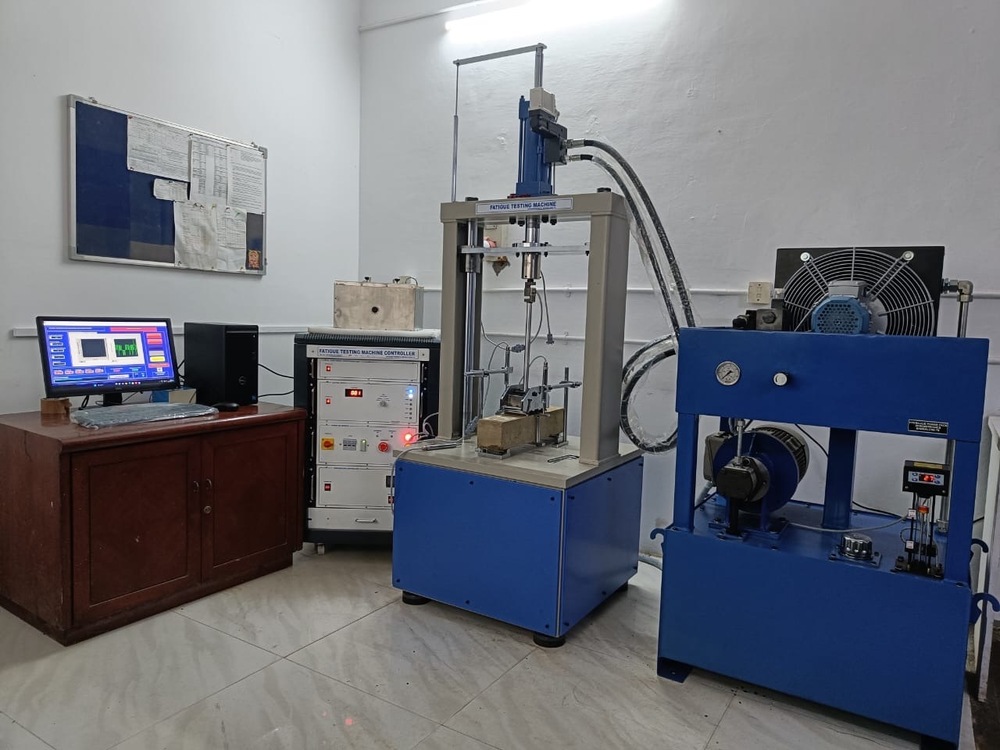
Fatigue Testing Machine for Concrete, Bitumen and Soil: Load Range :- 2T/5T Frequency :- 1-10Hz Hydraulic Actuation
Repeated Load
Testing Machine: Load Range :- 2T/5T Frequency :- 1-10Hz Hydraulic Actuation:- Haver Sine Wave Static Ramp Control:- Auto Computer Control load and Deformation
Rate of Load offrequency operation: Maximum 5Cycles/second.
The total systemis servo controlled.
Advanced Digital Control for Precise TestingThe machine boasts a state-of-the-art digital LCD control panel powered by microprocessor automation. This ensures highly accurate load application and cycle counting, greatly simplifying fatigue testing procedures for both novice and experienced users. USB and PC connectivity capabilities facilitate real-time monitoring and convenient data logging for thorough analysis.
Robust Construction and Safety FeaturesConstructed from corrosion-resistant mild steel and featuring self-lubricated bearings, this fatigue testing machine delivers reliability and durability. The system also includes a safety interlock for secure operation, making it a dependable choice for high-frequency laboratory and research use, compliant with both IS and ASTM standards.
Flexible Performance for Wide-Ranging ApplicationsWith a maximum load of 10 kN, adjustable stroke lengths, and compatibility with specimens of various sizes, this machine accommodates diverse fatigue testing needs. Its automatic and semi-automatic modes, as well as operational temperature flexibility, make it suitable for multiple materials and testing scenarios within academic, research, and industrial settings.
FAQs of Repeated Load Fatigue Testing Machine:
Q: How does the digital control panel enhance the fatigue testing process?
A: The digital LCD control panel, paired with microprocessor-based automation, allows for precise selection and monitoring of load, cycles, and operating parameters. This results in highly accurate and consistent fatigue testing, while simplifying user interaction and data recording through intuitive controls.
Q: What materials and sample sizes can be tested on this machine?
A: This fatigue testing machine is designed to accommodate specimens with diameters ranging from 10 mm to 50 mm, making it suitable for a wide range of materials commonly used in research and laboratory testing, including metals, polymers, and composites.
Q: When should the Repeated Load Fatigue Testing Machine be used?
A: The machine is best utilized when there is a need for high-precision fatigue testing of materials, especially to assess their durability under repeated loading. Its ideal for laboratories, research centers, and quality control environments requiring compliance with IS: 12673 and ASTM D-7369 standards.
Q: Where can data from fatigue tests be stored or further analyzed?
A: Test data can be exported through the machines USB or PC connectivity features, enabling users to conveniently store and analyze results on external devices using data logging and analysis software.
Q: What steps are involved in operating the testing machine?
A: Operation includes mounting the specimen, configuring the load, cycles, and stroke length on the digital control panel, and starting the test in either automatic or semi-automatic mode. The machine records the applied load and number of cycles until test completion or specimen failure.
Q: How does the safety interlock system protect users during operation?
A: The safety interlock system prevents the machine from operating when access panels are open or if unsafe conditions are detected, ensuring operator safety throughout the testing process.
Q: What is the benefit of using self-lubricated bearings and an air-cooled system?
A: Self-lubricated bearings reduce maintenance requirements and increase operational longevity, while the air-cooled system efficiently maintains optimal machine temperatures, allowing for prolonged, reliable operation.



 Send Inquiry
 Send Inquiry
 Send SMS
 Call Me Free


 English
 Spanish
 French
 German
 Italian
 Chinese (Simplified)
 Japanese
 Korean
 Arabic
 Portuguese