Product Description
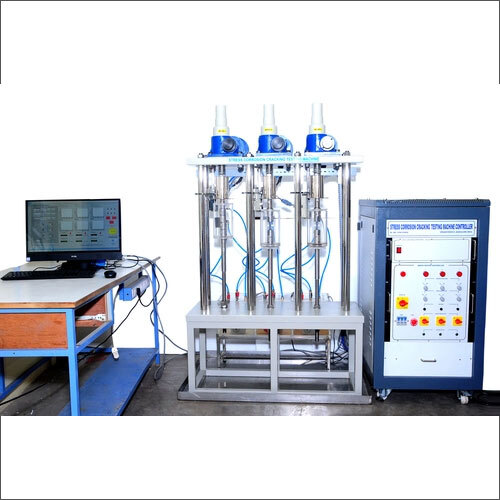
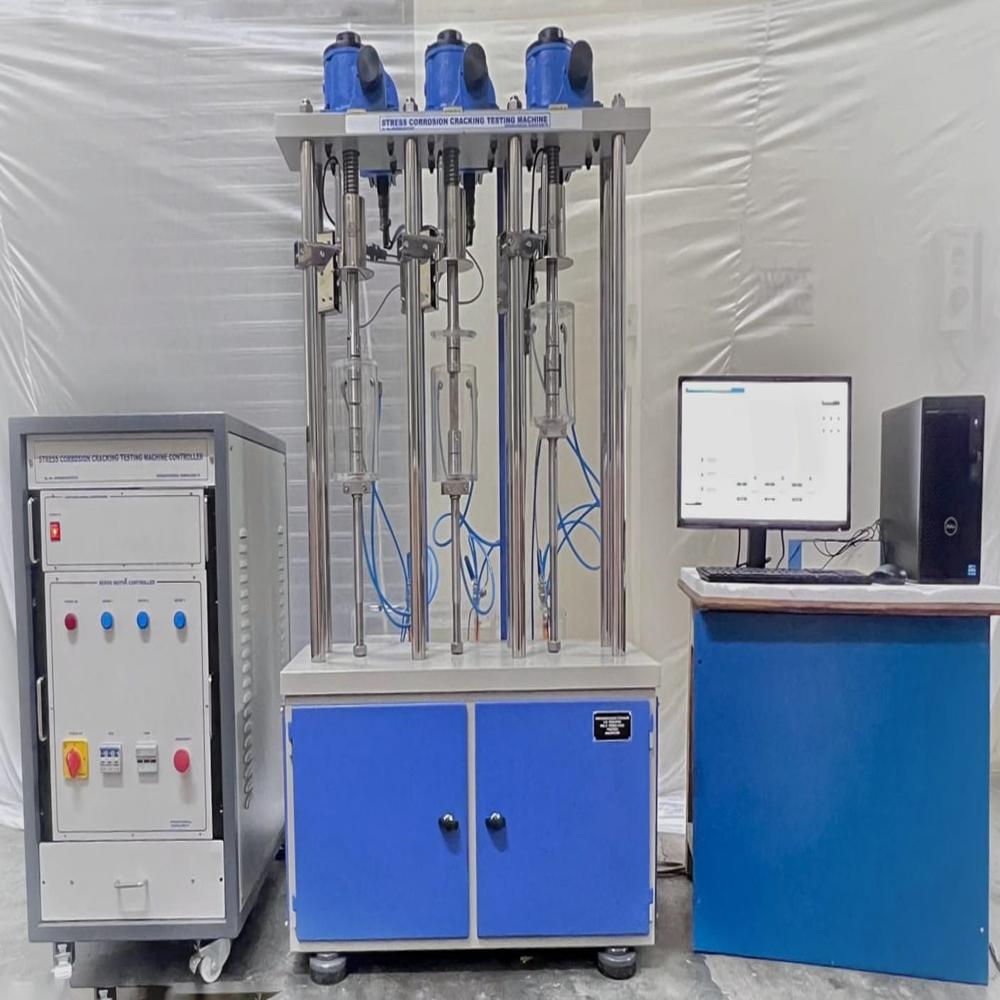
Constant SCC Test Setup
Standard Practice for exposure of Metals and alloys by alternate immersion in Neutral 3.5 percent NACI solution
The Constant SCC Test Setup with alternate Wet dry cycling facility ASTM G44 and G47 Standard
| Capacity
| 5 Tonnes frame with 3 parallel tests and specimen loading Facility
|
| Loading Type
| servo motor coupled with Gear box |
| Load Sensor
| Column type load cell attached to the Specimen loading train to indicate the applied load
|
Corrodant Container
| Acrylic corrodant container with inlet, outlet and over flow valves for alternate wet dry cycling system.
|
| Specimen
| Standard CT Specimen , Flat Specimen , Cylindrical Specimen |
| Data Acquisition System
| Lab View based Data Acquisition System for Load and Deflection data with respect to time |
Advanced Control and PrecisionThis SCC test setup incorporates microprocessor-based PID temperature control, delivering reliable and precise regulation throughout the testing process. Uniform temperature distribution within 2C across the test zone keeps thermal variables tightly controlled, ensuring the repeatability and accuracy of results, which is essential for credible material evaluation.
Versatile and Customizable DesignWith fully adjustable and customizable sample holders, the equipment can accommodate a diverse array of specimen geometries. Standard and bespoke sizes are available, making it suitable for both routine laboratory work and specialized research requirements. The robust stainless steel construction provides corrosion and heat resistance, extending instrument longevity.
Compliant and User-Friendly OperationConforming to leading international testing standards (ASTM G38, G39, G36), the digital interface enables seamless monitoring of temperature, load, and test duration via a clear LED display. Integrated safety features like emergency stop, over-temperature alarm, and safety interlocks prioritize user protection while supporting ISO 9001:2015 certified manufacturing standards.
FAQs of Constant Load Stress Corrosion Cracking Test Setup:
Q: How does the load application mechanism work in this SCC test setup?
A: The system employs either a constant dead weight or a lever-arm mechanism to apply consistent load to samples during testing. This ensures precise stress application throughout the experiment, which is critical for accurate stress corrosion analysis and compliance with international test methods.
Q: What standards does this apparatus comply with for stress corrosion cracking tests?
A: This test setup is engineered to meet ASTM G38, G39, G36, and equivalent international standards for stress corrosion cracking evaluation, ensuring reliable and traceable testing for material qualification and research purposes.
Q: When is it beneficial to use adjustable and customizable sample holders?
A: Adjustable and customizable sample holders are particularly advantageous when testing specimens of varied geometries, allowing users to efficiently switch between different sample types without requiring separate fixtures for each new test.
Q: Where is this SCC test solution most commonly used?
A: This equipment is widely utilized in material research laboratories, quality control departments, academic research centers, and industrial R&D facilities where evaluating the SCC resistance of metals and alloys is essential.
Q: What is the process for data acquisition during a test?
A: During a test, the multi-channel, computer-interfaced data acquisition system collects and records parameters such as temperature, load, and test duration. Users can monitor experiments in real-time and retrieve detailed data for analysis and reporting purposes.
Q: How does the system regulate temperature and humidity within the chamber?
A: PID-based digital controls ensure uniform temperature distribution (2C) up to 300C, while an integrated or optional humidifier manages humidity levels as required. This allows simulation of diverse environmental conditions for realistic stress corrosion testing.
Q: What are the key benefits of this SCC test setup for users?
A: Key advantages include precise environmental regulation, versatile specimen compatibility, robust safety features, comprehensive data logging, and compliance with international standards, all of which enable efficient, accurate, and safe stress corrosion testing.







 Send Inquiry
 Send Inquiry
 Send SMS
 Call Me Free


 English
 Spanish
 French
 German
 Italian
 Chinese (Simplified)
 Japanese
 Korean
 Arabic
 Portuguese