Product Description
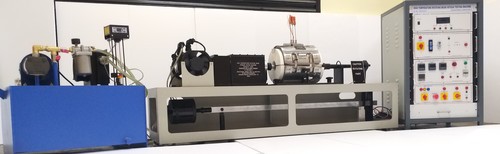
Rotating Beam Testing Machine. Available in diverse technical specifications to meet clients specific needs, the machine provided by is manufactured using superior quality components and advanced technology. This machine is extensively used to determine the fatigue property of beam. Clients can purchase this Rotating Beam Testing Machine from us at pocket friendly prices.
Maximum Capacity: 10 nm
Temperature Range:Ambient to 1000 Degree C, 3 Zone
Gripping Diameter: 7 mm
Gripping Length: 20mm
Specimen Length: 60 mm
Rotational Speed: 1000 to 3000 RPM
Features:
- Rugged construction
- Sturdiness
- Hassle free performance
- Longer operational life
Superior Temperature Control SystemEquipped with a NiCr heating coil and high-temperature resistant insulation chamber, the machine delivers precise regulation of operating temperatures up to 900C. For further versatility, forced air and optional water cooling systems ensure stable and repeatable fatigue testing at both room and high temperatures.
Reliable Digital Performance and Data ManagementThe integrated microprocessor controller allows programmable test cycles, adjustable speed, and digital monitoring via an LCD screen. Essential test data is conveniently logged through the USB interface, facilitating traceability and post-test analysis for quality assurance.
Robust and Safe ConstructionConstructed with stainless steel fixtures and a durable alloy composite housing, the device offers corrosion and oxidation resistance even at elevated temperatures. Safety is paramount, with features like over-temperature protection, motor overload routines, safety interlock, and emergency stop mechanisms.
FAQs of High Temperature & Room Temperature Rotating Bending Fatigue Testing Machine:
Q: How does the fatigue testing machine control and monitor temperature during high-temperature tests?
A: Temperature is controlled using a high-performance NiCr heating coil and monitored by built-in sensors. The thermal insulation chamber maintains uniform heat distribution, allowing stable testing up to 900C. Over-temperature protection ensures safe operation throughout the test.
Q: What types of specimens can be tested and how are the fixtures customized?
A: Standard specimen diameters up to 10 mm can be securely mounted using hardened steel clamps and grips. Custom fixtures are available to accommodate varied sample geometries and sizes, enabling versatility for different testing needs.
Q: When is forced air or water cooling necessary during fatigue testing, and how is it implemented?
A: Forced air cooling is typically used for room temperature and moderate high-temperature tests, while optional water cooling provides enhanced temperature regulation during prolonged or extreme heat cycles. Selection depends on test duration, temperature requirements, and material properties.
Q: Where can the machine be installed, and what are the power and space requirements?
A: It is designed for laboratories, research centers, and manufacturing facilities. The machine operates on a standard 220V AC supply and requires a space approximately 1100 mm x 700 mm x 1200 mm, weighing around 180 kg, with dimensions customizable as needed.
Q: What is the typical process for running a rotating bending fatigue test on this equipment?
A: Operators program test parameters via the LCD microprocessor interface, mount specimens, set the desired temperature and speed, and initiate the cycle. The machine executes up to 100 million cycles, with real-time data logging and in-built safety mechanisms throughout the process.
Q: How does this machine benefit users in terms of compliance and accuracy?
A: It meets international standards like ASTM E466/E606 and IS 5072, ensuring that results are reliable and universally accepted. Precise digital controls and integrated calibration guarantee measurement accuracy within 1% of the observed value.
Q: What safety and reliability features are included for operator protection?
A: The system incorporates a safety interlock, emergency stop, motor overload protection, over-temperature routines, and a robust insulated enclosure, all designed to minimize operational risks and safeguard both users and equipment during testing.





 Send Inquiry
 Send Inquiry
 Send SMS


